

New York City
NYC Council grills Mamdani admin over communication with influencers
Council members still have questions for the Office of New Media – who didn’t testify – about its activities.
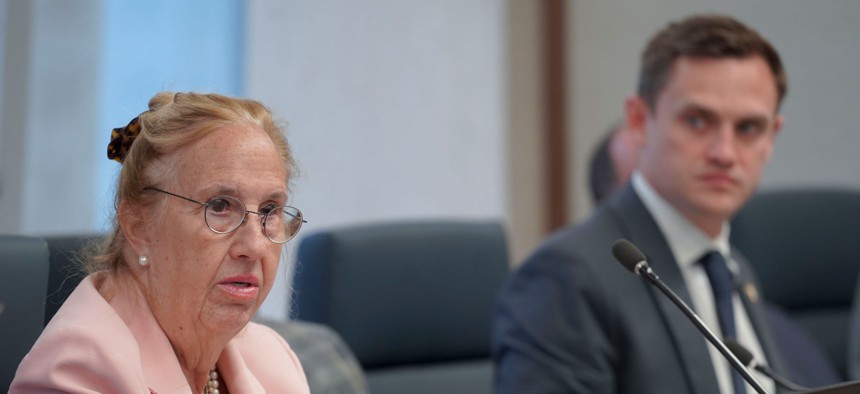
New York City Council Member Gale Brewer led Tuesday’s hearing on the Mayor’s Office of New Media. Gerardo Romo / NYC Council Media Unit.



New York City Mayor Zohran Mamdani’s Office of New Media may be novel, but City Council members raised some familiar complaints about it at an oversight hearing on Tuesday.
Council members blasted the administration for not sending officials who could answer questions about its communications with influencers to the hearing, arguing that their absence made it impossible to get answers.
The hearing, held by the Committee on Governmental Operations, State and Federal Legislation, was convened in response to reports that the Mayor’s Office of New Media was using the encrypted messaging app Signal to relay talking points to more than 200 social media influencers. The news, first outlined in the Columbia Journalism Review late last month, ignited a firestorm around the practice.
Responses to the story ranged from outright accusations that the Mamdani administration was peddling propaganda to more measured concerns about how the use of a platform like Signal doesn’t encourage transparency. The fact that the app allows users to set messages to automatically delete is one such concern, potentially hindering the city’s document retention policy and its ability to comply with the Freedom of Information Law.
But the crux of council members’ ire at Tuesday's oversight hearing was the absence of Emilia Rowland, director of the Office of New Media and Cultural Communications, and that of any other officials from the communications office. Despite being the person best equipped to answer questions about the Signal group and the administration’s communication with influencers – given she leads the office and has overseen the group chat – Rowland declined an invitation to testify at the hearing. The two city officials who did attend, Tascha Van Auken, commissioner of the mayor’s Office of Mass Engagement, and Shawn(ta) Smith-Cruz, commissioner for the Department of Records and Information Services, were unable to answer specifics about the office’s budget, what social media influencers have been contacted and whether said communications violated city rules.
“The panel that was sent here was sent missing crucial components, crucial parts of the administration who could talk in more detail about the very topic of the hearing we’re looking to address,” City Council Minority Leader David Carr said. “It’s incredibly disappointing and outright ridiculous that we’re having a hearing on a very important topic, a topic that was clearly defined, and no one who is able to talk about the meat and potatoes of this issue.”
Frustrations spanned the political aisle.
“As everyone knows, I have a great respect for this administration, so it upsets me that they have me agreeing with Council Member Carr,” Public Advocate Jumaane Williams, a progressive Democrat, said. “I don’t know what to say except the right people should be here.”
Williams added that while he’s not sure that the Mamdani administration did anything wrong, Rowland’s absence did nothing to quell the concerns that have arisen.
Asked at an unrelated press conference on Tuesday about the oversight hearing, Mamdani reiterated that his administration took “corrective action” to ensure they are in compliance with the city’s record-keeping laws after concerns about the Signal chat were raised.
“I’m confident in the testimony that our administration is providing today, that it will be sufficient in answering the council's questions,” he added, referencing frustrations about who did and didn’t testify.
City officials’ decision to skip an oversight hearing on the city’s rollout of the pied-à-terre tax last month drew similar criticism from council members.
Without Rowland, much of the hearing kept coming back to the city’s instant messaging policy, which pertains to the recording of electronic messages. According to that policy, city employees are allowed to delete "transitory messages” that don’t document an agency’s “decisions, actions or policies.” Instant electronic messages are “considered transitory by default,” the policy continues, meaning there is no expectation of it being archived.
The exception to this is if the message’s content is “substantive” in which case a record should be preserved. “If a user determines the content of a message is substantive and should be maintained, the user is charged with transferring the content to a format more appropriate for long term storage and use,” it reads.
Council members repeatedly pressed for further information about how substantive is defined –– and more specifically, about whether the Mayor’s Office of New Media’s Signal chat meets that definition.
The answer to that question, according to Smith-Cruz, is up to the respective agency and individual users.
“It’s really up to the user,” she said. “One should, in the utterance of the words, have a sense of whether something is transitory or not, substantive or not, before they decide what platform it should not exist on.”
“In my world of 40 years, that means it needs some help in terms of defining what (substantive) is,” Brewer responded.